Since the inception of Everyone Here, West Cumbria’s Arts Council England-funded Creative People and Places programme, the University of Lancashire has assumed the role of Learning Partner, which is split between John Scanlan and Ursula Pool (our colleague in the School of Health, Social Work and Sport).
As an arts programme, Everyone Here can boast two unique features: one is its Citizen’s Jury (known as the Jury for Joy) and the other is its Community Evaluation Group, which is a sub-group of the Jury who undertake to evaluate the work of the programme.
John has been closely observing the workings of the Community Evaluation group since it first met and began to develop its novel methods, which aim to create an environment within which members of the community who are now - in this role - involved in commissioning arts programming can better understand the processes at work. As well as adding more depth to their engagement with the programme, they gain experience that also equips them with the knowledge and skills needed to gradually assume a greater role in the commissioning of Arts Council-funded activity, which is one of the purposes of the Creative People and Places programme.
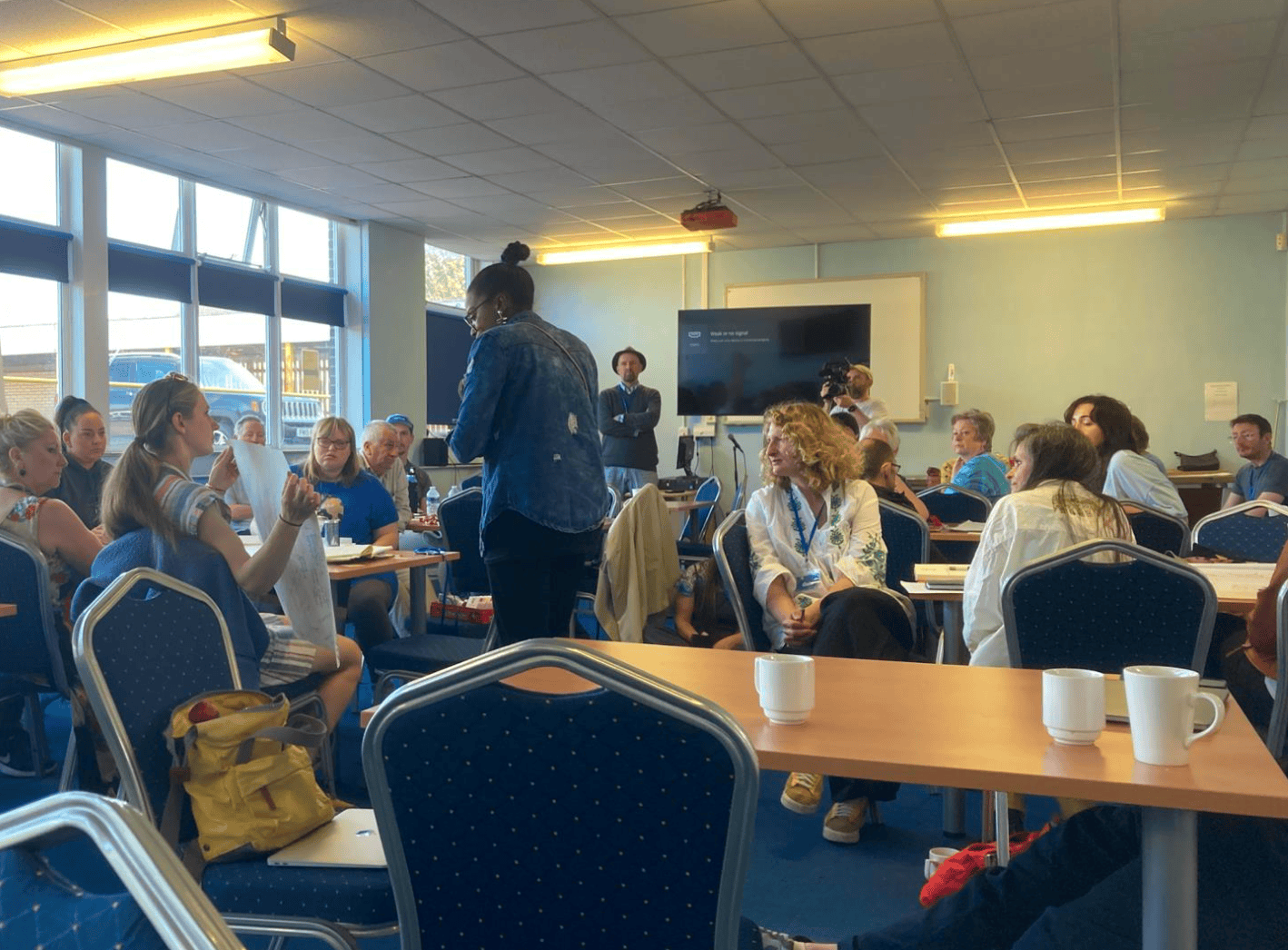
Evaluation meetings, which were partly facilitated by artists engaged by Everyone Here, involved the group engaging directly in forms of creativity. This has helped to change the group perception of what evaluation is and who it is done by, challenging the idea that only an ‘expert’ can be an evaluator. Observing this from a sociological perspective, and in an effort to try and provide the Everyone Here creative team with some insights into how the evaluation framework was taking shape, it became apparent that in these closed group settings certain ‘metaphors of the social’ (see table below) were more applicable than others.
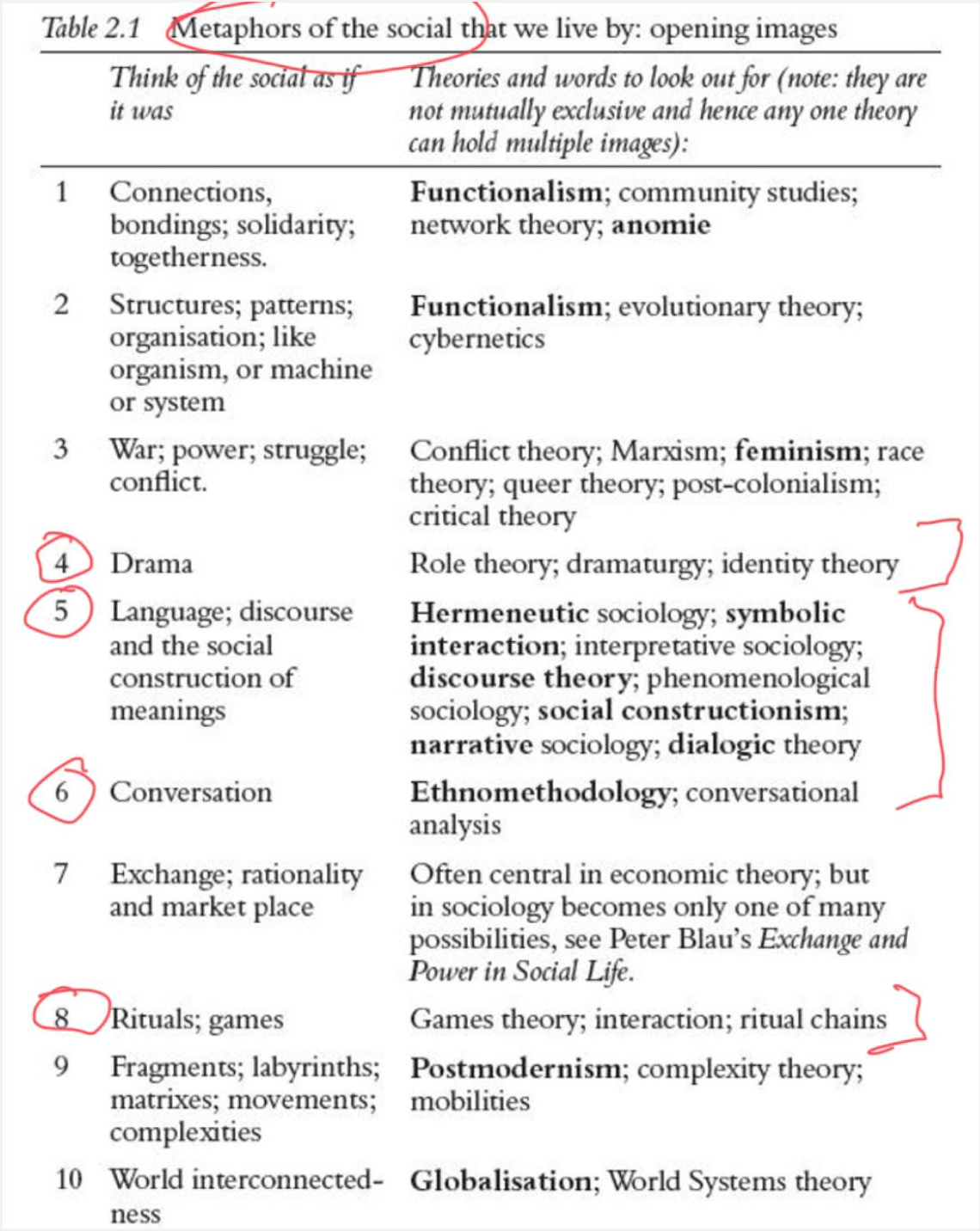
Table from Ken Plummer, Sociology (Routledge, 2010)
Sociologists working in the symbolic interactionist tradition, for instance, in which drama is a key metaphor for understanding human social relations, would point to the ‘staging’ of these evaluation meetings and how this staging, within an open and exploratory process, will have some impact on what subsequently takes place. But all of the ways of thinking of the social that are circled in this table could be seen to apply to understanding how this community evaluation group developed certain situated practices. Number six, for instance, where ‘conversation’ is a key metaphor for how we interact at a social level, relates to the sociological sub-discipline of Ethnomethodology (which should not be confused with ‘ethnography’) is sometimes described as a form of 'methodological situationism'.
It is also not a method in the way we might think; rather it is a sociological approach to the world that reveals the methods that are used by people to work out the situation they are in. It seeks to reveal how an ordered social reality is accomplished on an ongoing basis.
To return to the meetings, beginning from the fact that members of the evaluation group had no prior knowledge of what form the evenings would take, they may have been caught by surprise when the creative researchers introduced elements of play into the sessions (such as working with clay). From a sociological (symbolic interactionist) perspective we can reasonably say that the purpose in doing this was not simply as a means of easing people into the session, but was to shift attention away from what might conventionally be thought of as the kind of actions, behaviour or expertise that were associated with work of a supposedly ‘serious activity’ such as evaluation (which, in the popular imagination, is something undertaken by consultants or scientists of one kind or another).
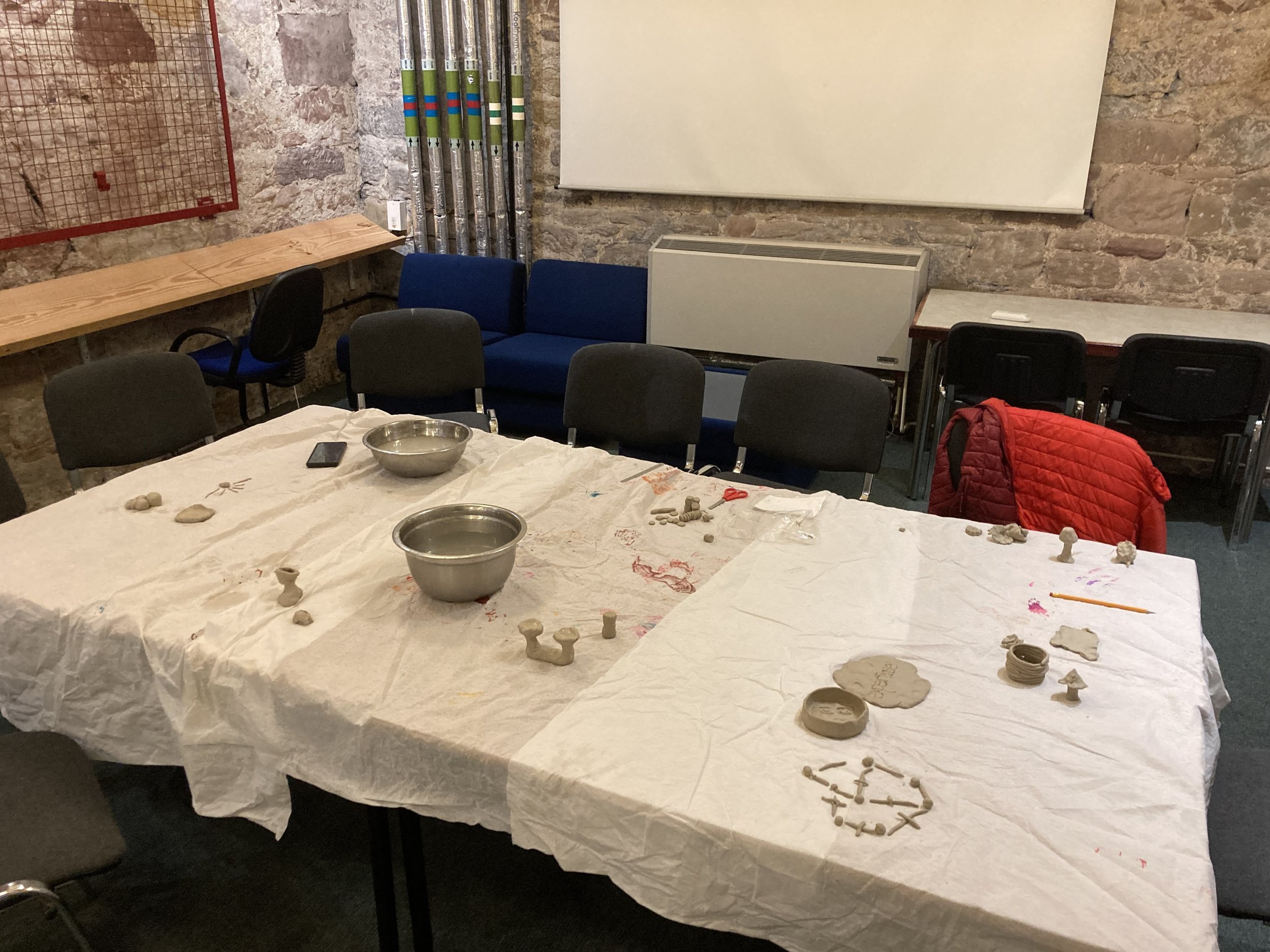
Clay play
The point of the community evaluation model, by contrast, is to enable these participants, who are also Jury members, to be the ones who would undertake evaluation. There is, in other words, no real separation between those tasked with considering the evaluation questions and the things that they are evaluating: at this stage, they have been part of the commissioning or approval of many of the programme’s activities. In that sense, it becomes a self-reflexive process in which the participants learn from their prior actions as members of the Jury for Joy.
In staging the session in this way, the creative researchers ensured that the group were suddenly in a situation that they never expected to be in.
The American sociologist Erving Goffman’s focus on the importance of everyday rituals as the taken-for-granted glue that binds us together, and more specifically his ‘dramaturgical analysis’ of social interaction, offers a means of bridging the apparent gap between the spheres of play and seriousness, which were brought together in some of the community evaluation sessions. Goffman posited the idea that everything we do, all the roles we fulfil or partake in (as parent, son, daughter, receptionist, teacher, and so on) can, in fact, be understood from a dramaturgical perspective. That is not to say that we act out scripted roles in our everyday lives, but rather to point to the fact that the performative aspect of social interaction engages us in forms ‘impression management’ that are play-like. As such, play and games can reveal much about how ‘normal’ interactions arise and ‘play out’.
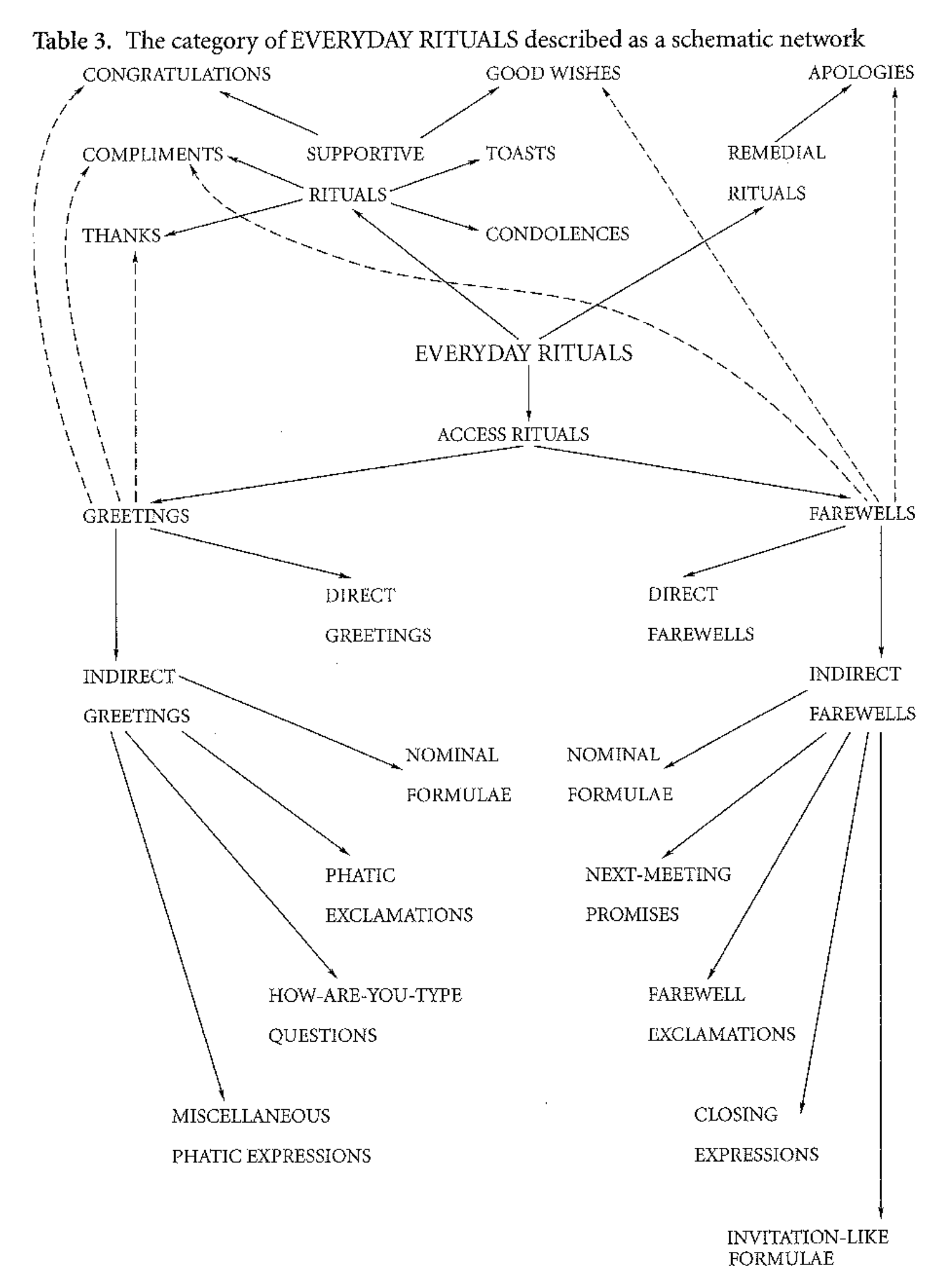
Ewa Jakubowska, 'Everyday rituals in Polish and English', in Meaning Through Language Contrast, Vol. 1, eds , Katarzyna Jaszczolt and Ken Turner (John Benjamins Publishing, 2003): 336. This diagram presents an example of the subject matter of Goffman’s ‘microstudies’ of social order.
For Goffman this meant that what is of interest in looking at particular instances of social interaction is the relation between role and self (not between self and other). So, we can ask, was adopting the role of an evaluator (something that we think only experts do) really to step far outside one’s sphere of competence? Or did the discussion around play, creativity and expertise, produce an awareness that ‘acting’ as an evaluator in this context, was not much different than taking on the other roles that members of the group had become adept at handling inhabit within specific settings in their everyday lives?
I bring this thought into consideration because the evaluation method can be understood to be based on a set of approaches that are deployed as the situation demands. They are additionally part of a process that is not only about ‘evaluation’, per se, but about bringing to the evaluation group an awareness of what constitutes creative activity within certain contexts that influence also how we think about it. The objective is not only to answer the key questions that Arts Council England have set for the Creative People and Places programme, in general (which is to say, the questions that all CPPs must respond to), but to prepare the evaluation group to be able to seek out and commission forms of creative expression or engagement suitable for an arts programme like Eeveryone Here.
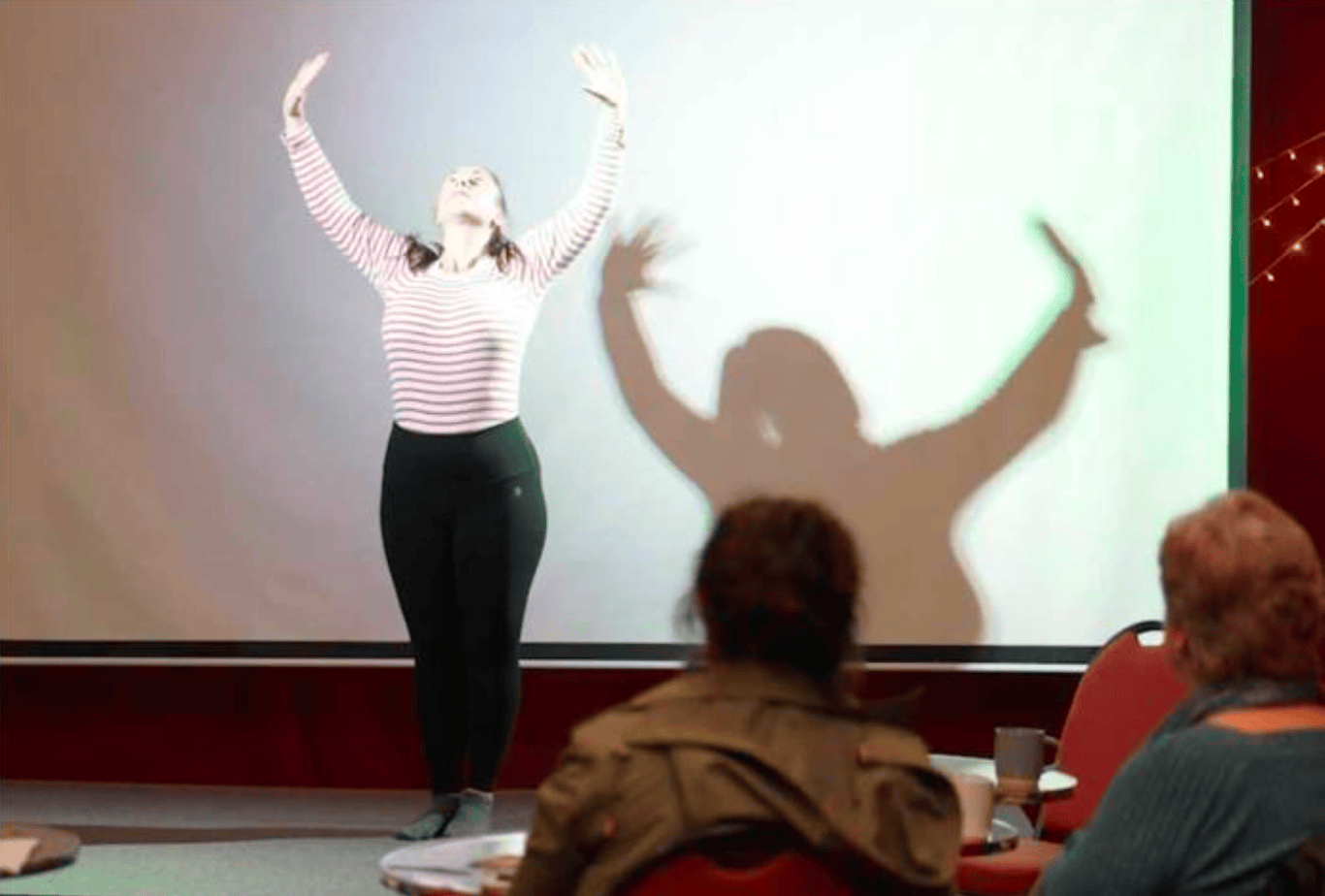
Creative researcher / movement artist, Beth Loughran-Layton during a community evaluation session.
With reference to Goffman’s dramaturgical perspective on social interaction, we would also highlight the importance of creative researcher Beth Loughran-Layton’s contribution, which could be described as a synthesis of the serious and the playful – a combination of work and play – which was represented in non-verbal physical gestures and through the body. She later said to the group that what she intended to show was that creative expression has a dual purpose in another way, in that it can embody the kind of ‘working out’ (in the sense of ‘practice’ or exercising a capacity) that makes us ‘fit for purpose’. And that in cumulative terms, the more we can express ourselves creatively, the more we can break through the inhibitions that may hold us back from such outward forms of expression that put us in what Goffman would describe as a centre stage position, exposing us to a certain kind of scrutiny we may be unfamiliar with.
The uncertainties of play challenged the group to respond in words or images. Implicitly, this form of artistic expression – a kind of non-verbal, non-written communication – will result in a multiplicity of reactions, as those who are present engage imaginatively to interpret what they experience. That the group did so – by standing up and presenting their feelings and thoughts to the rest of the group – further highlighted the dramaturgical aspect of this new ‘role’ that they were now playing, and which may have contradicted everything they had come to understand about the meaning of ‘evaluation.’
More about our role as Learning Partner, and the insights we bring to understanding this Creative People and Places programme, can be found in this recent report, Everyone Here in West Cumbria: Culture, Infrastructure and Ecology (2026)