Place Guides

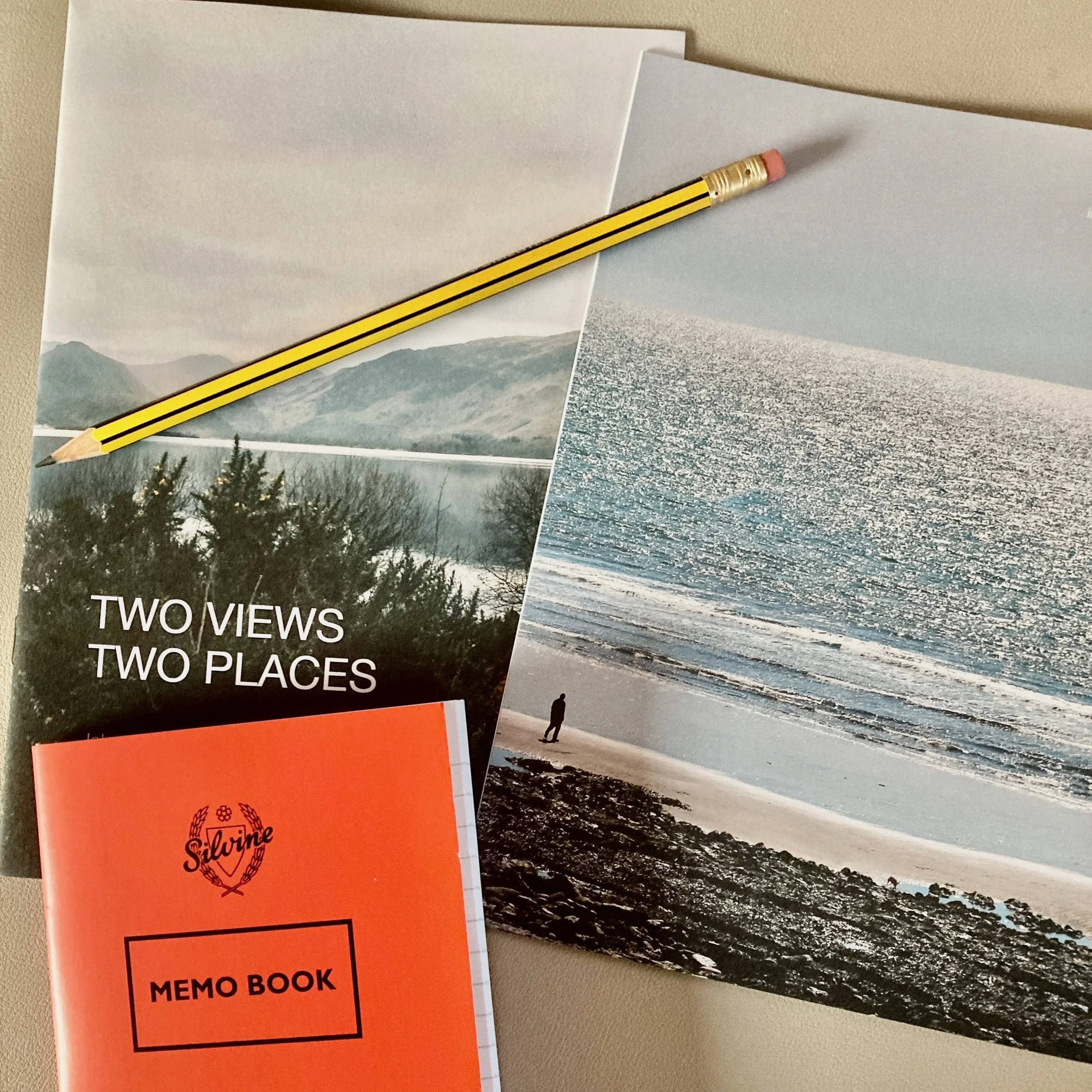
These short place guides were developed in 2019 from research that I had previously undertaken for other (more academic) purposes to be used by Eden Arts of Penrith, as part of a consultancy process they undertook on the A66 coast-to-coast road. They were quickly put together and were not intended to be comprehensive place guides (of the 'Rough Guide' kind), but were rather given as illustrative examples of how one might develop itineraries that focused on attractions on the west coast of Cumbria for visitors taking day trips by car. They were intended to inform Eden Arts' 'Route 66' initiative.

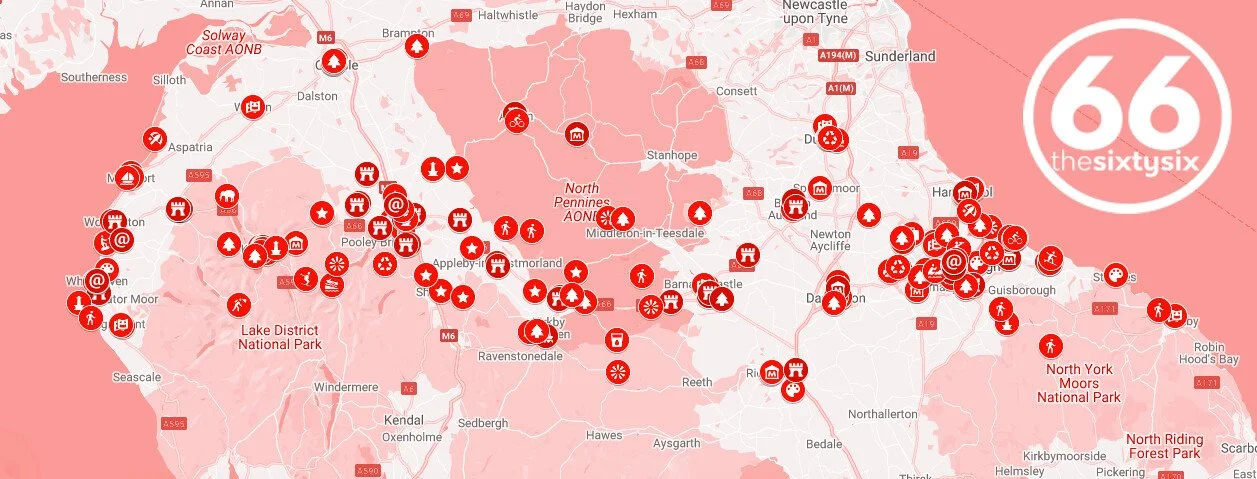
Image via Eden Arts

Now renamed 'The 66', the Eden Arts initiative is now a wide-ranging partnership designed to promote and develop the region defined and joined by the A66 road. It seeks to uncover the potential of the road as a key economic and social driver. These guides, along with my book West Cumbria: On the Edge and another article about the history of the A66 (published in the journal Places) could be considered as contributions towards efforts that seek to re-imagine / re-make the region's identity.

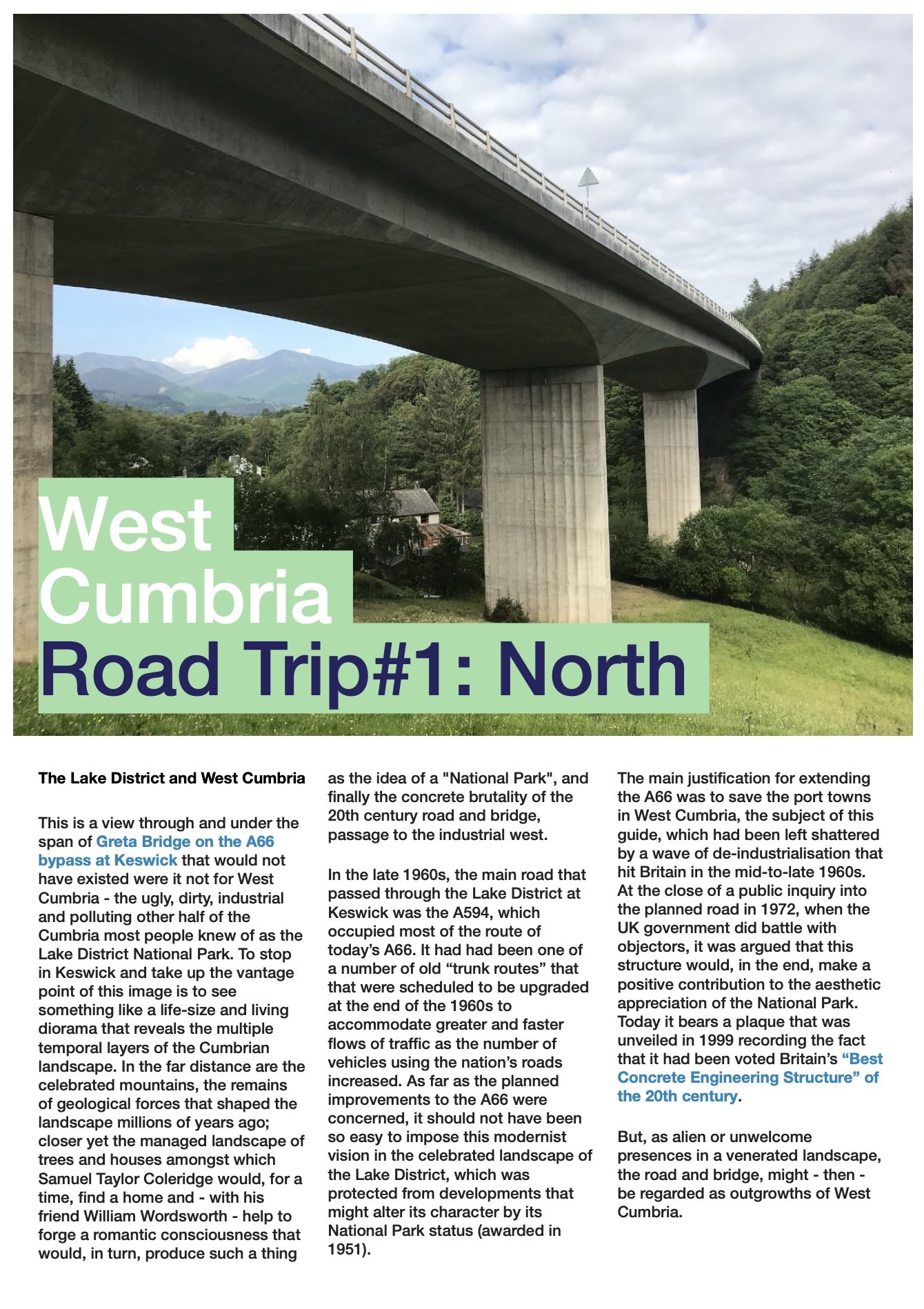
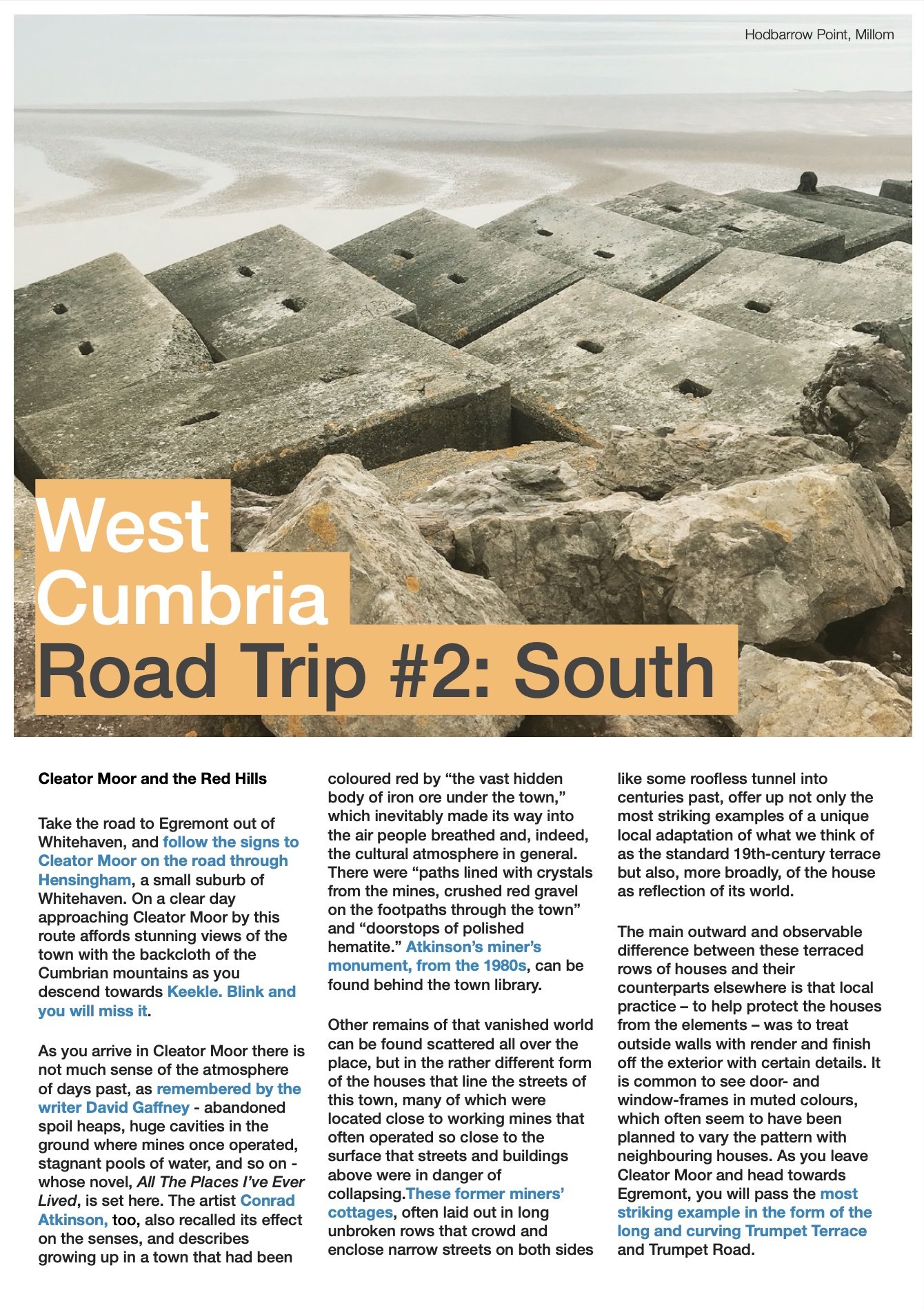
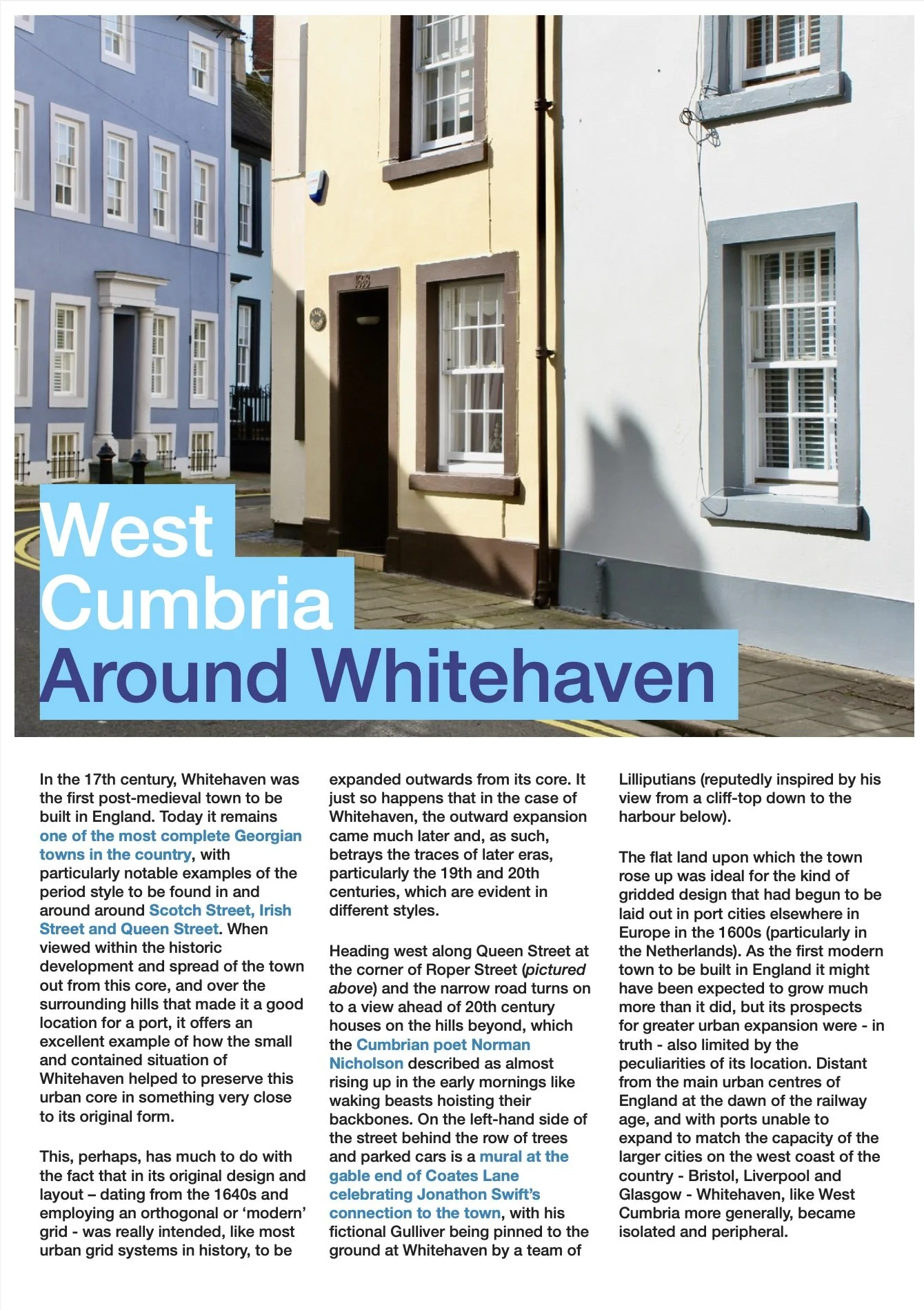
Each guide was designed to suggest a route that could be accomplished in one day, say, for a day visitor travelling from the A66 through the northern Lake District to the west coast of Cumbria. As such, there was material shared between the three guides, although each one departs on its own itinerary towards a different destination.

Cultural Memory

‘The Present Superimposed on the Past or the Past Indwelling in the Present: Explorations of Cultural Memory Mediated through Curated and Creative Forms’

This PhD research explores how cultural memory is mediated through place identity and images of place. It will additionally examine the wide range of curated and creative forms, strategies and other means that are employed as vehicles for cultural memory, and how these are used to inform, educate and generally communicate with the public. The research will focus on the town of Whitehaven in Cumberland and explore the many facets of cultural memory that have become important in how the town portrays its relationship to the past. It will do this through the use of interviews, archival materials, the analysis of heritage initiatives, and original research-led curatorial initiatives to explore and make public the value of local forms of cultural expression. The unique contemporary political, cultural, and economical situation in Whitehaven provides an opportunity to uncover broader insights into the relationship between past and present, including the extent to which Whitehaven’s history influences its contemporary character and identity. Recent events in Whitehaven, such as the failed plans to open a new coal mine and the attempt to preserve aspects of its mining past in the now closed Haigh Mining Museum show that Whitehaven is a place that is defined in the present, not only by the past, but by how the past is always shaped for present purposes.

Whitehaven additionally provides an excellent case study for understanding how important the arts are to cultural memory: it contains an abundance of placemaking public art centred around its harbour, which is part of a wider ‘heritage landscape’, and one of its only exhibition spaces, The Rum Story, is currently undergoing a ‘reimagining’ project. Both provide an op-portunity to explore how the relationship between past and present is mediated through curated cultural and artistic practices that, for instance, constitute an important aspect of the town’s portrayal of its history and heritage. At this early stage in the research, three case studies that focus on distinctive place- and heritage-related initiatives have been identified:

• The ‘Renaissance of Whitehaven’ (millennium project)

• The West Cumbrian Carnivals exhibition

• The Rum Story Reimagined initiative

The project is underpinned by two principal assumptions that allow the research to be related to bigger questions: (i) that the past and present co-exist in personal, collective, and cultural forms and (ii) that place is key factor in mediating cultural memory. Cultural memory studies constitute an expanding multidisciplinary field within contemporary academia that brings together research in the arts and humanities, social sciences, and their sub-fields.

Conceptual and theoretical insights from this broad field can inform how we understand cul-tural memory as a phenomenon of contemporary society. In that respect, this PhD project will contribute to the wider debates that seek to understand contemporary life.

Ecologies

Project title: ‘Cultural Infrastructure and Cultural Ecology’

In the early phases of our work, research was concerned with the concept of ‘place’ and with what made West Cumbria such a singular place: its tangible and intangible cultural heritage, its unique history and topography, its peripheral location. Addressing issues related to an initial focus on ‘place development and promotion’, we found that the challenge of making the region more visible to outsiders depended to some extent on discovering or developing a unique sense of place — an image of place, or place identity — that might convey something of the cultural distinctiveness and unity of a sub-region that is, at the same time, comprised of many smaller places with their own distinctive identities and senses of place.

John’s role included a substantial practical element, through which he developed a range of collaborations and partnerships with local cultural actors (organisations, institutions and individuals). Building on what has been learned from the initial phases of research and the col-laborative and partnership networks that we have developed, our sustained focus on ‘cultural infrastructures’ and ‘cultural ecology’ will underpin the broad approach to examining issues around questions of place and culture for the duration of this plan. This necessitates new research to investigate the interrelationship of the various cultural, economic, social spheres of life in the region, not only as an aspect of understanding how they shape present knowledge, policy and practice, but in terms of how the coming together of interests – for purposes that are often temporary or contingent in nature – illustrates new forms of partner-ship working. One aspect of the research in this regard is to understand the ways in which cultural policy in the region is often defined not through forms of governance that would situ-ate local authorities as a key player, but through the emergent practices of make-do initiatives, and / or the efforts of unofficial and non-funded cultural actors in the region. This is linked intimately to the well-known lack of economic diversity in the region, which also restricts the development of cultural infrastructure.

One aim of developing a body of conceptual and descriptive work on the nature of cultural infrastructure and cultural ecology is to be able to more effectively communicate the nature and realities of place to those within fields of policy and practice who, in seeking to be more responsive to public needs, can benefit from our specialist knowledge and understanding.

Regeneration

This research project (running from 2026-29) examines the structures, dynamics and processes through which place-based cultural initiatives succeed or fail in meeting cultural policy objectives, which we define as nurturing the human capacities that allow people to flourish. It will explore this question within the contexts of:

  • attempts to stimulate diversification in the economy of West Cumbria that led to a range of cultural regeneration initiatives between the 1990s and the present, and

  • the impact of local government re-organisation on the governance of place and culture following the creation of the new unitary authority of Cumberland Council in 2023, which absorbed the former West Cumbria boroughs of Allerdale and Copeland.

By bringing together research expertise in cultural sociology, history, policy studies, and urban geography the research seeks to understand what constitutes place governance in Cumberland today. Through interviews, archival research, workshops and cultural policy analysis, it will also inquire into the part played by a wide variety of cultural actors and stakeholders, policy makers and local government officials, and situate their experience within the broader contexts within which they are able to act. We want to find out what it takes to make West Cumberland a prosperous, healthy and vibrant place.

While this project aims to address the contemporary governance of West Cumbrian society, it is important to insist on the extent to which the critical point in shaping the present – as far as the focus on place and culture is concerned – lies in the recent past.

As part of our research into the nature of the partnerships that exist today, we discovered the extent to which a large number of rather different kinds of partnership emerged during regeneration initiatives in the 1990s. These, it seemed clear, were formed by the unique circumstances of the time and aimed at creating greater economic diversification in West Cumbria in the wake of potentially catastrophic cancellation of THORP (the Thermal Oxide Reprocessing Plant, which promised thousands of jobs) at Sellafield.

This prospect laid bare the extent of the region’s economic dependence on a single dominant industry. In the decades since this critical point, there have been many cultural regeneration initiatives that sought to re-orient the economy of the region away from its dependency on the nuclear industry. Often, these initiatives took the form of re-imagining West Cumbria. Some of these delivered benefits to the public (the C2C cycleway, a project undertaken with a wide array of partners) and others received much publicity and promised great things but failed to deliver.

This project will look at the extent to which such initiatives, continuing into the present, and other factors such as local government re-organisation, have managed to shift the balance of influence with respect to the governance of West Cumbrian society away from the main economic player, and what lessons can be taken from past experience.