*
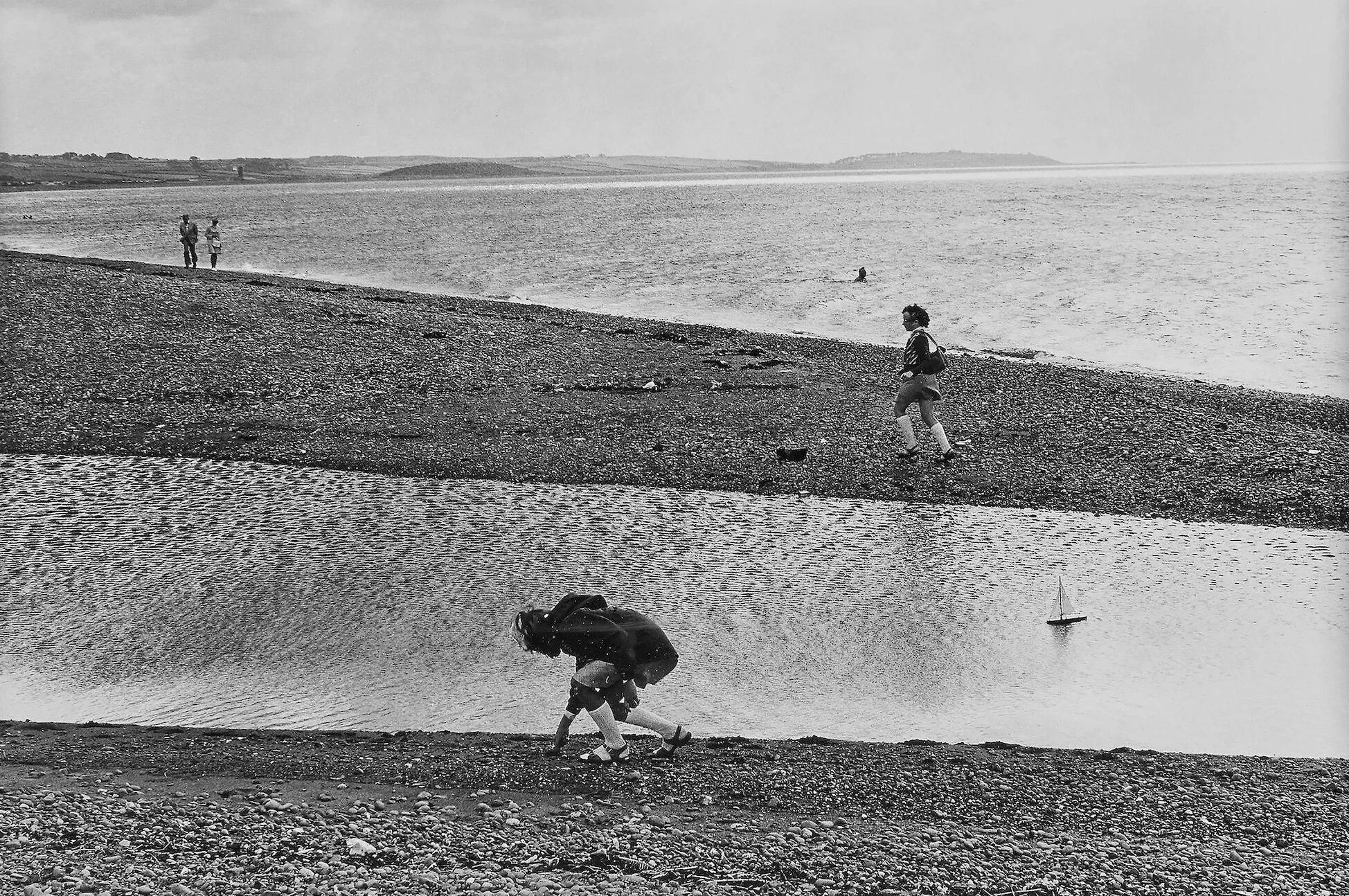
If the edge of place can be thought of in terms of the undeniable sensation of reaching a boundary – evident in the smell and sound of the sea, for instance – there is nonetheless a more mysterious sensation of having reached some kind of limit that invites another way of looking. This sense of being on the edge of something – the edge of time or history and certainly at the point where the past and present seem to have split from each other, between one world and another – drew the attention of the photographer Raymond Moore in the 1970s and 1980s.
Moore, then regarded as one of Britain’s foremost photographers, found himself pulled towards places in West Cumbria that seemed to have been overcome by a profound sense of marginality. He was particularly attracted to a number of seemingly unremarkable places along the Cumbrian coast, such as Allonby, Harrington and Silloth, which in his work take on a significance that exploded them out of their geographical position to make them more revealing of something much broader about the human condition in a changing world. To be there, he felt, was like being at ‘the edges of civilization.’ Moore’s images of West Cumbria provide glimpses into a place where things, in one way or another, look as if they have always been running out – at the edge of land, time and opportunity – or seemed to have already reached some kind of terminal, post-future condition.
Looking at the places that Moore took an interest in is a bit like finding snapshots from some imagined post-apocalyptic future. For some, the images ‘look desperate and haunted’, as if Moore ‘had been chased across England to water’s edge and was now dodging washing lines and garbage bins looking for a place to hold out.’ Even in the examples of his work that are devoid of human figures, and sometimes marked only with fleeting signs of life (a child’s swing, a bedsheet catching the wind on a laundry line, a road sign poking out of a misty emptiness, animals looking as if they have been abandoned), he was able to articulate something of the cultural landscape that West Cumbria had become, almost as if he had grasped the ‘cultural wholeness’ of the place in its post-industrial moment, which these images, as fragments of something bigger, managed to convey.