*
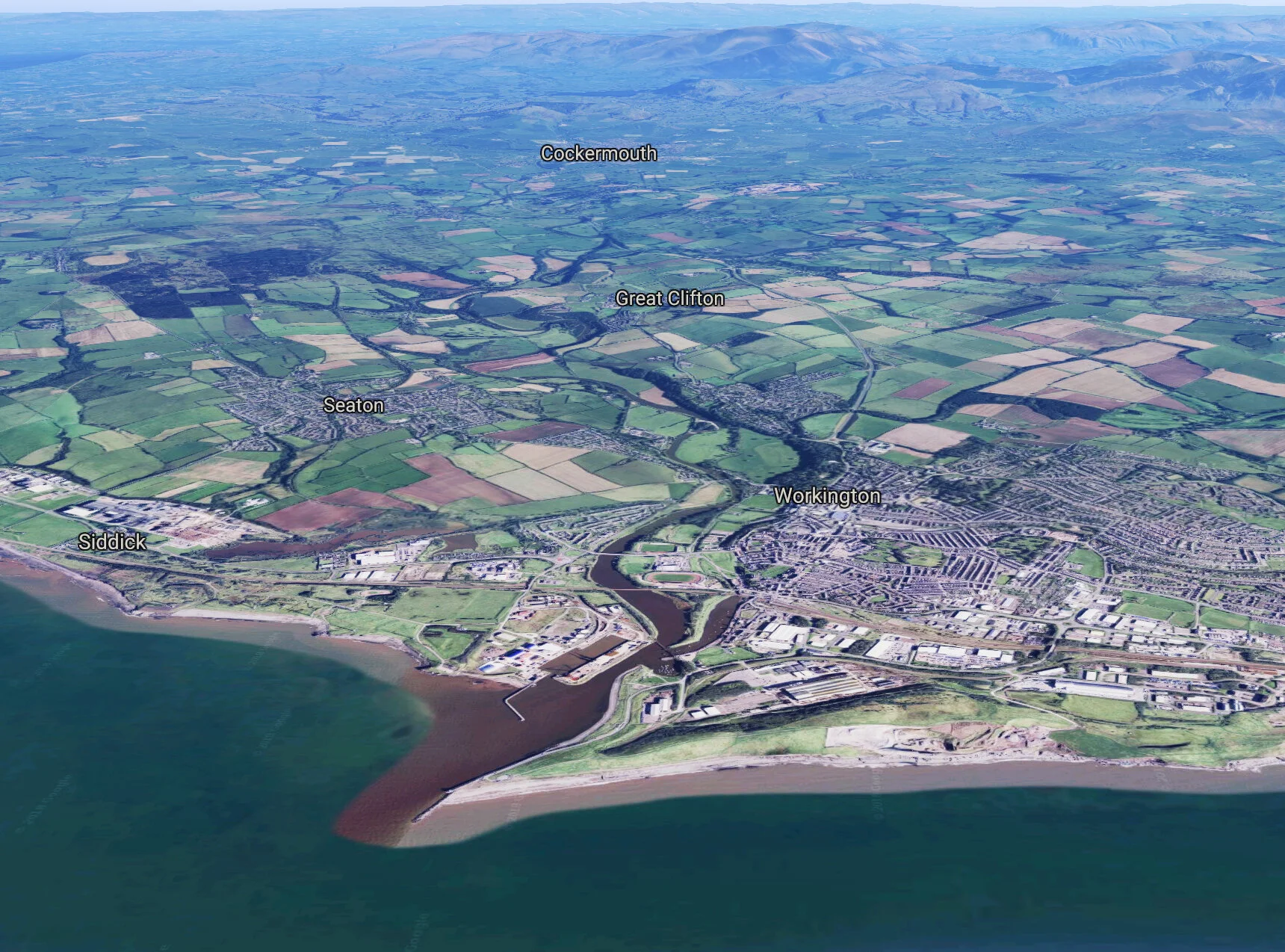
The coastline of Cumbria is about 100 miles long, stretching from somewhere around the location of the picturesque northern hamlet of Rockcliffe – nestled in the armpit of the Solway Firth, right where Scotland and England meet – to Grange-over-Sands in the south. ‘West Cumbria’, though, has more often than not referred to a sub-region that was defined as much by its economy and industry as its geographical boundaries. Today it would be taken to refer to a smaller area – the former industrial West Cumberland – extending inland from the coast on the flatter plains that are wrapped around the mountainous terrain and natural boundary of the Lake District and from Silloth in the north (also a product of industrial Cumbria) to Seascale midway down the coast.
West Cumberland also included the town of Millom even further south, which is now – and always was – a place that seemed to exist in isolation, ‘surrounded on three sides by the sea and with the exit to the north almost blocked’ by the imposing form of Black Combe, a peak of 1970 feet, making Millom almost ‘an island’. It is a land that was once rich in minerals, with coal and iron ore (of the highest quality hematite found in the British Isles) driving the development of industry between the 17th and 20th centuries and the growth of towns like Workington, Whitehaven, Maryport, Cleator Moor and Egremont.
Such was the lure of its coastal location for industry that once, at the turn of the 20th century, the entire population of Dronfield, Yorkshire, moved to Workington, along with the relocating Cammell Laird steelworks that employed them, which itself was transported piece by piece to the Cumbrian coast to be reassembled. What these transplanted men and women, and others drawn in from the countryside or more distant regions, would have seen and heard as they approached the steelworks daily was a very familiar sight in Sheffield – that of the glowing smelting ovens, sparks flying and giant towers pumping smoke and steam into the sky above, accompanied by the deafening sound of machinery and steam hammers. An isolated corner of England turned into a 24-hour-a-day world. Even today, when much of that industrial West Cumbria has vanished, there are still places where industry and production shape the environment, with the skyline around the coast on the approach to Workington still dominated by sights that are characteristically in tune with its past.